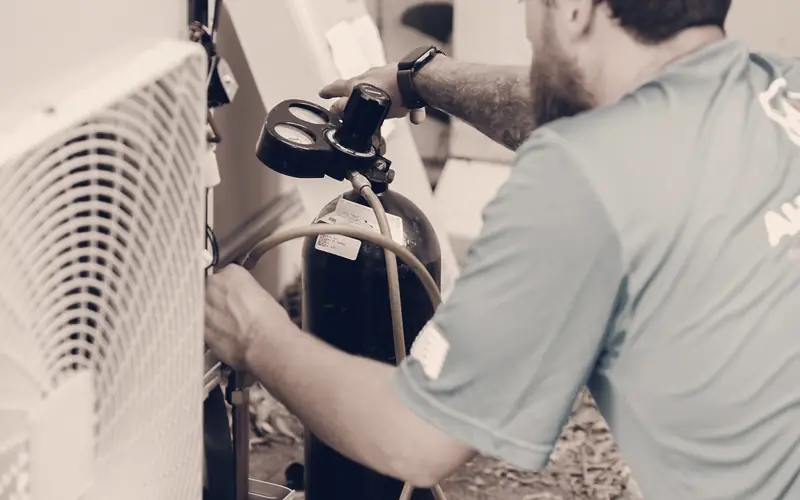
Short Answer: The NATE Core exam has 50 questions in 1.5 hours, closed book. Basic electricity is the largest area at 26%, followed by safety at 18%.
Quick Facts
| Questions | 50 |
|---|---|
| Time | 1.5 hours |
| Largest area | Basic Electricity, 26% |
| Next largest | Safety, 18% |
| Our NATE bank | 52 questions; Basic Electricity is the largest group |
What the Core Exam Is
North American Technician Excellence (NATE) is a non-profit certification organisation for HVACR technicians. On its traditional pathway, a technician passes two exams: the Core exam and one specialty exam. The Core exam tests the general knowledge every technician should have. According to NATE, it has 50 questions, a 1.5-hour time limit and is closed book.
NATE publishes the topics for each exam in documents called Knowledge Areas of Technician Expertise (KATEs). The Core KATE splits the exam into seven areas:
| Knowledge area | Approximate weight |
|---|---|
| Basic Electricity | 26% |
| Safety | 18% |
| Temperature and Humidity Measurement | 14% |
| Achieving Desired Conditions | 14% |
| Tools | 10% |
| Basic Science | 10% |
| Basic Construction | 8% |
With 50 questions, that works out to roughly 13 electrical questions, 9 safety questions, 7 each on humidity measurement and desired conditions, 5 each on tools and science, and 4 on construction. NATE can change the KATEs, so download the current version from NATE before you study.
Basic Electricity (26%)
This is the largest area and the one most candidates find hardest. Focus on:
- Ohm’s law: E = I × R. A 240 V circuit through 12 Ω carries 20 A.
- Power: P = E × I. A 24 V control circuit carrying 0.5 A uses 12 VA.
- Series circuits: resistances add, and current is the same through every component.
- Parallel circuits: voltage is the same across each branch, and total resistance is lower than the smallest branch. Two equal resistors in parallel give half the resistance of one.
- Components: transformers, contactors, relays, capacitors, thermostats and their functions.
- Meters: a voltmeter is connected in parallel with the load, an ammeter measures current (clamp meters read the magnetic field around one conductor), and an ohmmeter is used only on de-energized circuits.
Practise reading simple ladder and wiring diagrams. Know how a 24 V control circuit energizes a contactor coil, which then closes the line-voltage contacts to the compressor and outdoor fan.
Safety (18%)
Safety questions focus on what a technician should do, step by step, to avoid injury.
- Lockout/tagout. OSHA’s standard on the control of hazardous energy (29 CFR 1910.147) requires isolating energy sources and applying locks and tags. Always verify zero energy with a meter before you touch conductors.
- Electrical safety. Treat circuits as energized until tested. Use insulated tools and proper PPE.
- Pressurized gases. Nitrogen cylinders can hold over 2,000 psig, so always use a regulator and a relief device when pressurizing a system. Never use oxygen or compressed air to pressure test.
- Brazing. Keep oil and grease away from oxygen fittings. Flow a small amount of nitrogen through tubing while brazing to prevent oxide scale.
- Refrigerants. Most refrigerants are heavier than air and can displace oxygen in confined spaces. Liquid refrigerant can cause frostbite, so wear safety glasses and gloves. Flammable A2L and A3 refrigerants need extra precautions.
- Chemicals. Safety Data Sheets (SDSs), required by OSHA’s Hazard Communication Standard, list hazards, handling and first aid.
- Ladders and lifting. Inspect ladders before use, set them on firm ground, and lift with your legs.
Temperature and Humidity Measurement (14%)
This area tests psychrometrics, the study of air and moisture.
- Dry-bulb temperature: the air temperature on a normal thermometer.
- Wet-bulb temperature: the temperature of a thermometer with a wet wick in moving air. Evaporation cools it below dry-bulb unless the air is saturated.
- Dew point: the temperature at which air becomes saturated and moisture starts to condense.
- Relative humidity: the amount of moisture in the air compared with the most it could hold at that temperature.
Key relationships: when dry-bulb and wet-bulb are equal, relative humidity is 100%. Heating air without adding moisture lowers its relative humidity. Cooling air below its dew point removes moisture, which is how an evaporator coil dehumidifies.
Know the tools: sling or digital psychrometers, hygrometers, and how to read a psychrometric chart.
Achieving Desired Conditions (14%)
This area connects equipment to comfort.
- Comfort factors: temperature, humidity, air movement and the temperature of surrounding surfaces all affect comfort. ASHRAE Standard 55 describes thermal comfort conditions.
- Sensible and latent loads: sensible heat changes temperature, and latent heat changes moisture content. A home with high humidity can feel warm at the right temperature.
- Airflow: dirty filters, closed registers and undersized returns reduce airflow and raise static pressure.
- Ventilation: bringing in outdoor air dilutes indoor pollutants. ASHRAE Standard 62.2 covers residential ventilation.
- Controls: how thermostats, set points and differentials keep conditions in range.
Tools (10%)
Know which tool to use and how to use it safely.
- Manifold gauges read high- and low-side refrigerant pressures.
- Micron gauges verify deep vacuum during evacuation.
- Manometers read static pressure in inches of water column.
- Anemometers measure air velocity.
- Multimeters, clamp meters and megohmmeters test voltage, current, resistance and insulation.
- Torque wrenches tighten flare nuts and fasteners to the manufacturer’s specification.
- Thermometers and psychrometers read temperature and humidity.
Basic Science (10%)
- Heat moves from warm to cool. A refrigeration system uses work to move heat the other way.
- Heat transfer: conduction through solids, convection through moving fluids, and radiation through space.
- Units: one Btu raises one pound of water 1°F. One ton of refrigeration is 12,000 Btu/h. One watt is about 3.412 Btu/h.
- Pressure and temperature: raising the pressure on a liquid raises its boiling point. Atmospheric pressure at sea level is about 14.7 psia, or 0 psig.
- Sensible and latent heat: sensible heat changes temperature, and latent heat changes state.
Basic Construction (8%)
Technicians work inside buildings and must not damage them.
- Framing: residential studs are usually 16 or 24 in on centre. Codes limit how much you can notch or bore joists and studs.
- Insulation: higher R-value means more resistance to heat flow.
- Vapor retarders: slow moisture movement into walls and ceilings.
- Air paths: return air paths keep rooms from pressurizing and starving the system of air.
Worked Examples
These short examples show how Core questions often combine two ideas. They are original examples, not real exam items.
Electrical. A 240 V condenser fan motor and a 240 V compressor are wired in parallel from the same contactor. What voltage should each see when the contactor closes? Because parallel branches share the same voltage, each should see about 240 V. If the compressor reads 240 V but does not start, the problem is in the compressor circuit, such as its capacitor or windings, not the supply.
Humidity. Room air reads 75°F dry-bulb and 75°F wet-bulb. What is the relative humidity? When the two readings are equal, no water evaporates from the wick, so the air is saturated at 100%.
Science. A system removes 36,000 Btu/h. How many tons is that? Divide by 12,000: 3 tons.
Safety. A technician needs to pressure test a new line set. What gas and equipment should be used? Dry nitrogen through a regulator, with a relief device, to a pressure within the equipment manufacturer’s limits.
A Study Plan
- Download the current Core KATE from NATE.
- Spend about a quarter of your time on electricity, because it carries about a quarter of the score.
- Review safety rules you use every day and make sure you can explain why each exists.
- Practise reading a psychrometric chart until you can find relative humidity and dew point quickly.
- Take our NATE Core Practice Test (50 Questions), which has 50 questions per attempt and an optional 90-minute timer, and review every explanation.
Once you are ready for Core, read NATE Specialty Exams Explained to choose your second exam.
Common Mistakes
- Mixing up series and parallel rules. In series, current is the same. In parallel, voltage is the same.
- Measuring resistance on a live circuit. It can damage the meter and gives false readings.
- Confusing wet-bulb with dew point. Wet-bulb is between dry-bulb and dew point, except when the air is saturated and all three are equal.
- Pressurizing with oxygen. Use dry nitrogen with a regulator.
- Skipping construction. It is only 8%, but those points are easy to earn.
Where to Go Next
Steps to Take
- Download the Core KATE outline from NATE.
- Study electricity and safety first.
- Review heat transfer and psychrometrics.
- Take timed practice tests.
- Book your exam with a NATE testing organisation.
Frequently Asked Questions
Can I take the Core and specialty exams on the same day?
Many testing centres allow it, but check with your testing organisation. You need to pass both to earn NATE certification on the traditional pathway.
Is the NATE Core exam hard?
It is aimed at technicians with real field experience. Candidates who work in the trade and review the knowledge areas usually find it manageable. The electrical questions are the most common stumbling block.
Does NATE publish its passing score?
NATE reports results as pass or fail and says passing scores may vary slightly between test forms, so aim to score well above the minimum in practice.
Do I need EPA 608 before NATE?
NATE does not require EPA 608 for the Core exam, but federal law requires 608 certification to buy and handle regulated refrigerants, so most technicians earn it early.